Monday, February 19, 2007

Classes on Biomedical Optics:Class 1-Radiative Sources


The Oregon Graduate Institute (OGI) has been an amazing source of information throughout the simulation part of this project.
Here is the link to their course on Biomedical Optics:
http://omlc.ogi.edu/classroom/ece532/
From what I have understood, this course deals with how light is transported through a biological tissue.I have summarised it to make it clear to myself:
Class 1:Radiative Sources
If we put a power source in a box,and capture all the energy radiating from it,the rate of increase of the box's energy,per second, is its radiant power.
If we leave it on for a certain time,the total power output gives its radiant energy.
They have also given the example of Laser immersed in black water.
Note to myself:Maybe I could do the same kind of experiment to measure the radiation from the LED source we are going to use.

On the other hand,Radiant Intensity is the power of a source radiating energy into a cone in a particular direction, and it gives the power radiated per unit solid angle.
For instance,if we beam a flashlight onto a wall,the radiant intensity is the
power radiated x (area it falls on)/(total area).
In this case the total area is 4*pi*R^2 and the area it falls on is A.

Similarly,the radiant power per unit surface area is known as the Irradiance.

The Fluence rate,which is similar,refers to the radiant power that is present per unit cross-sectional area of a sphere.

The opposite of irradiance is given by radiant exittance which is the amount of light leaving a surface area.

A more difficult concept is Radiance, which gives the amount of light per unit solid angle(very small),per unit area(again limiting case).

Finally,they have discussed how light is collected.
Firstly,normal laser light can be collected via an aperture,and the irradiance is measured as an exponentially decreasing function of the central axis of the beam.
Secondly,an aperture is used to collect light from conical surfaces.
Thirdly,an integrating sphere is used to collect light.
Finally,the manner in which light is collected and guided by an optical fiber is explained.
An isotropic collector,which collects light with equal efficiency from all directions is also explained.
That's all with the first lecture.
When I study the next lecture , I'll be plunging deeper into biomedical optics.

Absorption Coefficient of Skin Melanosomes

The very first step to simulating the skin is to find out the value of absorption coefficent for the different layers of the skin.
This link provides an idea of the calculation of the absorption coefficient of melanosomes in the skin.
http://omlc.ogi.edu/spectra/melanin/mua.html
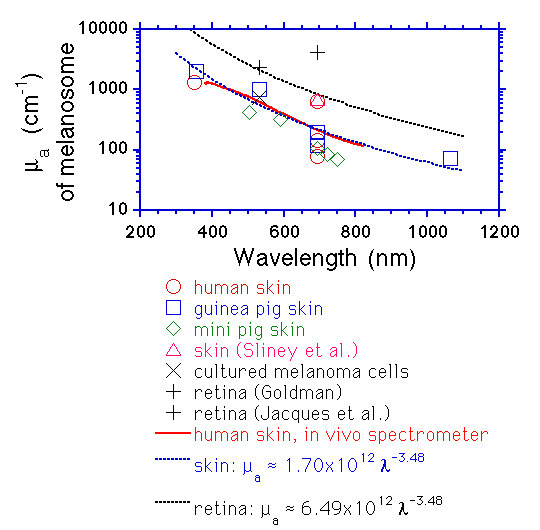
Further,they have provided a diagram that illustrates the variation of absorption coefficient of melanosomes for different types of skin,i.e. for human skin,guinea pig skin and the retina.
http://omlc.ogi.edu/spectra/melanin/jacques.mcauliffe.gif
There were 2 very broad conclusions I could make from this
1.The average value of absorption coefficient of melanosomes in human skin is
1.7 x 10^12 x [(lambda*)^-3.48]
*lambda is the wavelength of light used
2.The absorption coefficient of Melanosomes decreases with increasing wavelength of light,thus for lower wavelengths,eg.blue,the absorption will be more.
Two points need to be taken very important note of
1.We are only discussing Melanosomes,and not the total skin characteristics in the above case.
2.The units used are cm-1

Saturday, February 17, 2007

The discovery of SlideShare & the first review presentation

Thanks to Nipun Mehta the tech-wizard,(incidentally the only person in Silicon Valley to be compared to Gandhi (!)) and his fabulous organisation Charity Focus, I found out accidentally about a free,simple,easy to share software called Slideshare.
Nipun has a dream that the Internet will be converted into an Innernet,and it will be a tool where ideas,and not money, enjoy the place of being the primary currency.
The discovery of Slideshare and the no-fuss user interface offered has made me decide that all my presentations from now on will be uploaded using this software.
It never ceases to amaze me how these topnotch companies are able to offer their software free,but I, for one,am not complaining!
As a student, every day I find a new reason to confirm my hunch- that it is really not an exaggeration to say that the Internet opens up our horizons.
In addition,I think Slideshare was started by a bunch of Indian entrepreneurs and they have a team based in New Delhi.
Happy Slide-sharing ! :)

First Review posted

The first project review presentation can be seen here:
http://ideaz.myftp.org/nnj.ppt
Our thanks to Aditya Rajan for his generous domain hosting!